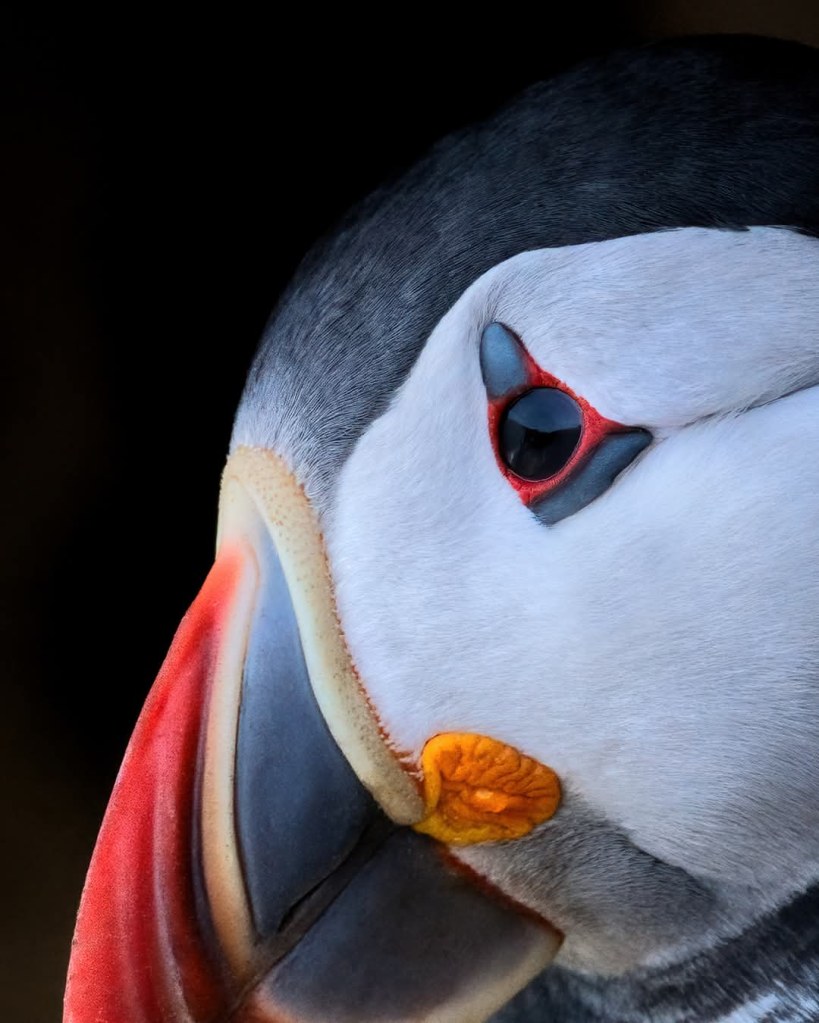

A few days after the Bard’s birthday we have been asked to write a sonnet, the poetic form so most connected with love. We weren’t given a subject today, but I had already primed my mind after seeing this photo yesterday taken by fellow bird enthusiast Stephen Beaver. who is also a member of the Yorkshire Birds and Birders group on Facebook, you can find more of his photos there..
It truly deserves to be loved and saluted in a sonnet. I tried, I hope it did Stephen’s image justice.
What miracle of winged joy is perched here?
Flown in on North Sea winds from who knows where,
Distant horizon glints in optic sphere,
Harlequin’s sadness without painted tears.
Did God, brush in hand, flush this face to life?
Or maybe Pablo and Dali combined,
And with magical palette subdued strife,
To paint bright visage with colours sublime.
Exquisite image, she’s no make-up gull,
Bright bejewelled Puffin, pure beautiful.
Ornate court jester, zesty, wonderful,
When I am with you, no moment is dull.
Give me no reason why you came to be,
Only this vision, marvel from the sea.
Additional information on Sonnets.
They should have –
• 14 lines
• 10 syllables per line
• Those syllables are divided into five iambic feet. (An iamb is an unstressed syllable followed by a stressed syllable). The word “admit” is a good example. In pronouncing it, you put more stress on the “mit” than the “ad.”
• Rhyme schemes vary, but the Shakespearean sonnet is abab cdcd efef gg (three quatrains followed by a concluding couplet).
• Sonnets are often thought of as not just little songs, but little essays, with the first six-to-eight or so lines building up a problem, the next four-to-six discussing it, and the last two-to-four concluding then conversation.
 Missives & Musings
I love the puffin photo, Graham, and your sonnet, and that we were both inspired by seabirds this morning. I can only agree with the lines:
‘Bright bejewelled Puffin, pure beautiful.
Ornate court jester, zesty, wonderful’.
LikeLike